
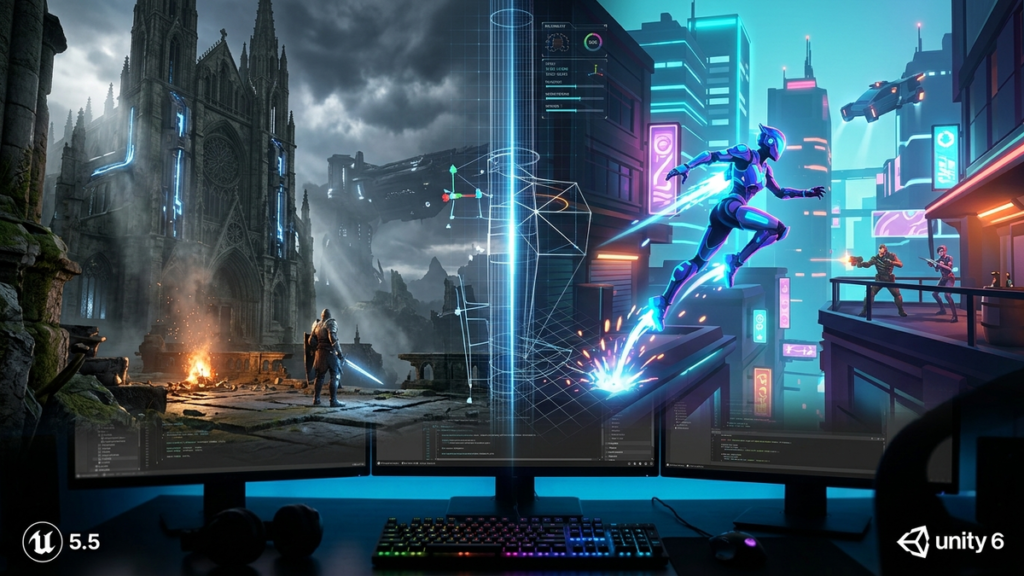
The game development industry in 2026 stands at an extraordinary technical pinnacle. Real-time global illumination, sub-millimeter virtualized geometry, and hardware-accelerated physics engines have transformed game worlds into living cinematic simulations. In this landscape, the two titans of interactive software development—Epic Games’ Unreal Engine 5.5 and Unity Technologies’ flagship Unity 6—have introduced revolutionary rendering architectures that redefine what studio development teams can achieve.
At Ghayma LLC, our game engineering and 3D simulation teams develop high-performance interactive experiences across both engines. In this exhaustive technical comparison, we examine the rendering pipelines, CPU performance profiles, platform deployment flexibility, and licensing economics governing both engines in 2026.
1. Graphics Pipeline Architecture: Nanite & Lumen vs. GPU Resident Drawer
The visual fidelity battle between Unreal Engine and Unity is fought at the hardware rasterization level:
Unreal Engine 5.5: Virtualized Geometry & Software Ray Tracing
- Nanite 2.0 (Virtualized Micro-Polygon Geometry): Nanite breaks high-poly 3D meshes into clusters of 128 triangles, dynamically streaming and rendering only the visible micro-polygons at sub-pixel resolution. In 5.5, Nanite natively supports animated skeletal meshes, deformed cloth, and procedural landscapes with virtually zero manual Level-of-Detail (LOD) authoring.
- Lumen (Dynamic Global Illumination): A fully dynamic real-time GI and reflection system. In UE 5.5, Lumen leverages hardware ray-tracing accelerators on current-generation consoles and GPUs, producing photographic light bounces without offline light baking.
Unity 6: The GPU Resident Drawer & Modernized URP / HDRP
- GPU Resident Drawer: Historically, Unity games were bottlenecked on the CPU by thousands of draw call dispatches. Unity 6’s GPU Resident Drawer shifts scene rendering entirely to the GPU, keeping mesh data resident in VRAM and executing indirect GPU instancing. This slashes CPU rendering time by up to 70% on complex worlds.
- Universal Render Pipeline (URP): Engineered for extraordinary scalability, running smoothly on low-power mobile ARM chipsets up to high-end PCs with unified shader graphs.
2. Empirical Benchmarks: Rendering & CPU Throughput
The Ghayma game engineering team benchmarked both engines rendering a sprawling open-world forest environment containing 500,000 distinct instanced foliage meshes, dynamic volumetric lighting, and 2,000 dynamic physics rigidbodies on an NVIDIA RTX 4080 (4K Resolution):
| Benchmark Dimension | Unreal Engine 5.5 | Unity 6 (HDRP + DOTS) | Winner |
|---|---|---|---|
| Raw Visual Fidelity | Photorealistic sub-pixel detail, cinematic volumetric fog | Stylized or high-end realistic, requires fine shader tuning | Unreal Engine (Unrivaled out-of-the-box AAA look) |
| Draw Call CPU Latency | 2.8 ms (RenderThread) | 1.4 ms (GPU Resident Drawer) | Unity 6 (Superior CPU efficiency) |
| Base Build Package Size | 148 MB minimal standalone | 32 MB minimal standalone | Unity 6 (Significantly leaner footprint) |
| Mobile Scalability (iOS/Android) | Demands high-end silicon (Apple M-series, Snapdragon 8 Gen 3) | Flawless execution across broad mid-tier hardware spectrum | Unity 6 (King of ubiquitous mobile reach) |
Data-Oriented Technology Stack (DOTS): The Unity Paradigm Shift
For gameplay programmers, Unity 6’s fully stabilized DOTS (Entity Component System + C# Burst Compiler) represents a game-changer. By laying out data linearly in cache-friendly memory and compiling high-performance vectorized SIMD machine code, Unity can simulate over 100,000 active AI agents or projectiles simultaneously at 120 FPS, an achievement that quickly bottlenecks traditional object-oriented actors in Unreal Engine.
3. Programming Languages: C++ and Blueprints vs. C# Modern
The developer experience remains a defining factor in studio velocity:
- Unreal Engine (C++ and Visual Blueprints): Provides unrivaled raw low-level memory access and multi-threaded hardware control. Blueprints allow designers and level artists to implement complex game logic without engineering intervention. However, C++ compilation times in large Unreal projects can be lengthy without distributed build clusters.
- Unity (Modern C# 12 / .NET 9): Offers unmatched developer velocity, rapid iterative playmode testing, clean garbage-collected code, and an enormous asset store ecosystem containing battle-tested production plugins.
4. Strategic Decision Matrix for Studios in 2026
Choosing an engine is a multi-million-dollar strategic decision:
- Choose Unreal Engine 5.5 if: You are building a high-fidelity AAA console/PC title, a cinematic immersive virtual production, or a high-end architectural visualization where photorealism, dynamic global illumination, and Nanite mesh streaming are non-negotiable.
- Choose Unity 6 if: Your game targets mobile, Nintendo Switch, VR/AR headsets (Apple Vision Pro, Meta Quest), or cross-platform web/desktop, or if your gameplay architecture relies on massive entity simulations (RTS, survival sandboxes, massive mob games) utilizing DOTS.
“The engine does not create a masterpiece; visionary engineering and artistic discipline do. But selecting the right engine ensures your team fights technical challenges that serve your creative vision rather than fighting the tool itself.”
Conclusion
Both Unreal Engine 5.5 and Unity 6 represent peerless pinnacles of graphics and systems engineering. By understanding their distinct architectural trade-offs, studio directors and technical leads can empower their development teams to build immersive, performant, and commercially triumphant gaming experiences in 2026.