
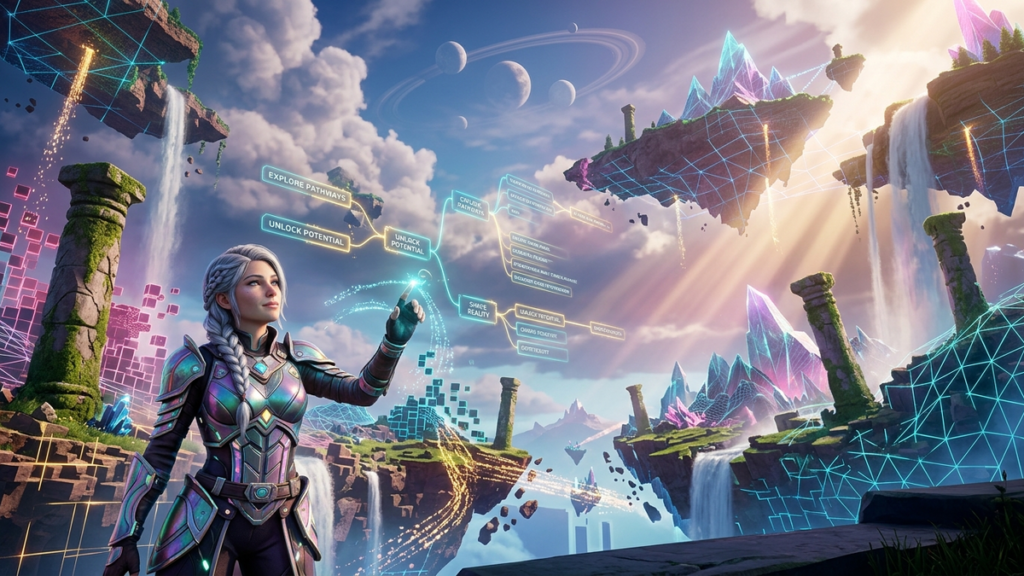
For half a century, video game design has relied on static, hardcoded narrative branching and painstakingly hand-sculpted level geometry. Non-Player Characters (NPCs) repeated the same three canned dialogue lines, and dungeon corridors were constrained by the number of hours environment artists could spend placing stone assets. In 2026, the convergence of advanced procedural generation algorithms and real-time on-device artificial intelligence has fundamentally disrupted game design.
Players no longer tolerate static, predictable worlds. Modern gamers demand infinite replayability, emergent narrative consequences, and NPCs with dynamic emotional memory. At Ghayma LLC, our game design engineers build intelligent worlds utilizing the Wave Function Collapse (WFC) algorithm and locally quantized LLM cognitive agents.
1. Procedural World Generation: Beyond Perlin Noise
While classic procedural titles like Minecraft utilized 3D Perlin/Simplex noise to generate heightmaps, noise functions cannot enforce complex architectural rules. Noise does not understand that a tavern requires a doorway, a chimney requires a fireplace, and a medieval fortress must possess continuous perimeter walls.
The Wave Function Collapse (WFC) Algorithm
Inspired by quantum mechanics, WFC generates intricate procedural structures based on local adjacency constraints derived from an example input:
- Every tile in an unobserved grid begins in a “superposition” of all possible building modules (e.g., Roof, Wall, Floor, Window, Door).
- The algorithm selects the tile with the lowest entropy (fewest remaining valid possibilities).
- It “collapses” that tile into a single definite state chosen via probabilistic weighting.
- It propagates constraint rules outward to all neighboring tiles, eliminating invalid states across the grid.
This process guarantees that generated villages, dungeons, and starship interiors are structurally coherent, aesthetically harmonious, and 100% bug-free with zero manual level designer intervention.
2. Living NPCs: The Architecture of LLM-Powered Dynamic Agents
In legacy RPGs, dialogue trees are static directed graphs authored in dialogue editors. Players click option A, B, or C. If a player wants to negotiate a peaceful surrender with an enemy bandit chief by offering him an alliance against a corrupt mayor, traditional game logic fails unless a writer explicitly pre-scripted that exact scenario.
The Autonomous NPC Cognitive Pipeline
Modern games run small, specialized quantized language models (e.g., Llama 3 8B INT4) directly on the player’s local hardware or dedicated server instances:
| Cognitive Subsystem | Technical Implementation | Gameplay Impact |
|---|---|---|
| Perception Engine | Spatial query & audio trigger listeners | NPC observes what the player is holding, wearing, or doing nearby |
| Semantic Memory Stream | Local Vector Store / SQLite | NPC remembers past player betrayals, gifts, and broken promises over hours of gameplay |
| Personality Prompt Matrix | Constrained System Prompt | Enforces lore boundaries, emotional temperament (e.g., greedy, paranoid, loyal) |
| Action Tool Caller | JSON Function Calling | NPC can trigger actual game events: trade items, unsheathe sword, flee, lock doors |
3. Preventing Hallucinations and Lore Breaking in Game Worlds
A primary hazard of generative dialogue in games is “jailbreaking”: a player telling an ancient fantasy blacksmith to give them a modern AK-47 assault rifle. Production game engines enforce multi-layered contextual guardrails:
// Structured NPC Output Contract (JSON Schema Constrained)
{
  "dialogue_text": "The blacksmith glares at your strange request. 'I forge steel for warriors, traveler, not imaginary thundersticks!'",
  "facial_expression": "irritated_suspicious",
  "affinity_delta": -5,
  "gameplay_action": "refuse_service"
}
By constraining the LLM to output typed JSON with strict enumerated gameplay actions, the game engine maintains total authoritative control over state changes while allowing creative, spontaneous dialogue variation.
4. Generative Audio & Real-Time Voice Synthesis
Text dialogue alone is insufficient for modern cinematic games. Leading studios integrate lightweight edge Text-to-Speech (TTS) models (such as StyleTTS 2 or Bark) coupled with dynamic phoneme-driven facial blendshape generators. An NPC’s voice modulation dynamically reflects their physical stamina, fear level, and health points in real time.
“The holy grail of interactive entertainment is a game that feels uniquely alive for every individual player. Generative AI and procedural mathematics are the tools that will finally make that dream a reality.”
Conclusion
AI-driven game design is not about replacing human creativity; it is about creating living game worlds that react dynamically to player imagination. By combining Wave Function Collapse procedural architecture with memory-backed conversational agents, game developers can construct boundless virtual universes filled with emergent adventure, genuine emotional depth, and infinite replayability.