
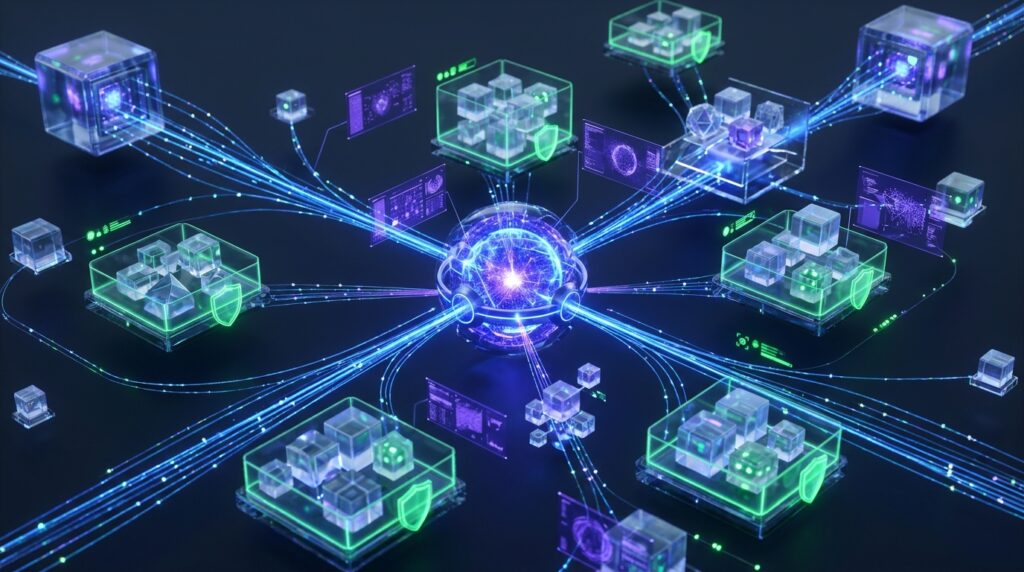
The era of conversational, single-turn chatbot interfaces in software engineering has reached its architectural plateau. As evidenced by the release of Thoughtworks Technology Radar (Volume 35) and new enterprise adoption benchmarks from the Capgemini Research Institute, the definitive engineering frontier of 2026 is the transition to autonomous multi-agent orchestration. When artificial intelligence models are unchained from synchronous chat windows and granted agency—the authority to autonomously plan, formulate hypotheses, execute shell commands, read abstract syntax trees, and refactor distributed repositories—the fundamental engineering challenges shift away from prompt syntax toward distributed systems reliability, sandbox containment, deterministic state coordination, and runtime governance.
1. Beyond the Chatbot: The Mechanics of Autonomous Execution Loops
A conversational LLM interaction follows an ephemeral request-response paradigm: a user provides input tokens, the model computes conditional probability distributions across its vocabulary, generates an output stream, and terminates execution. In contrast, an agentic system embeds the neural model inside a continuous, stateful execution loop modeled after the classical OODA loop (Observe, Orient, Decide, Act):
- Perception (Observe): Ingesting real-time telemetry from external runtime environments, including bash terminal outputs, compiler diagnostic error streams, git status diffs, and HTTP API responses.
- Cognitive Reflection (Orient): Evaluating runtime observations against the overarching goal, updating internal scratchpads, tracking dependency trees, and detecting deadlocks or infinite loops.
- Strategic Planning (Decide): Selecting the next atomic tool call from an available manifest of capabilities (file editing, web searching, test execution, database migration, or delegating work to a subordinate subagent).
- Tool Execution (Act): Invoking deterministic tools via standardized interfaces (such as Model Context Protocol – MCP), intercepting return codes, and looping back to the perception phase.
This continuous loop enables agents to solve open-ended problems that would fail in single-turn prompts. For example, an agent tasked with migrating a legacy Node.js service from CommonJS to ECMAScript Modules does not merely predict the code changes; it reads the source files, makes precise text substitutions, runs npm test, inspects the stack trace of failing unit tests, refactors the circular dependencies, re-runs tests until all suites pass, and generates a formatted git pull request.
2. Multi-Agent Orchestration Topologies: Hierarchical vs. Swarm
While a single agent loop is effective for isolated tasks, complex software engineering workflows overwhelm single-context architectures. Context windows, even when scaled to multiple millions of tokens, suffer from cognitive degradation (the “needle-in-a-haystack” attention dispersion phenomenon) and exorbitant quadratic compute costs. Modern systems therefore distribute cognitive labor across specialized multi-agent topologies:
Comparative Analysis of Multi-Agent Topologies
| Topology | Control Plane | Latency & Cost | Deterministic Guarantees | Best Suited For |
|---|---|---|---|---|
| Hierarchical Dispatcher | Central Supervisor Agent | Moderate (O(N) tokens) | High (Strict validation gates) | Enterprise codebases, CI/CD pipelines |
| Autonomous Peer Swarm | Decentralized Gossip / Pub-Sub | High (O(N²) chatter) | Low (Emergent consensus risks) | Exploratory fuzzing, penetration testing |
| Blackboard Architecture | Shared Global State Memory | Optimized (Vector + KV store) | Very High (Immutable audit log) | Complex distributed microservices |
The Hierarchical Supervisor Architecture
In enterprise engineering environments, the Hierarchical Supervisor Model dominates. A primary “Parent” or “Architect” agent receives the overarching user specification. Rather than executing shell commands directly, the supervisor decomposes the objective into an acyclic task graph (DAG). It invokes specialized, short-lived “Worker” subagents (such as a Codebase Researcher, a Database Migration Specialist, or an Automated Test Author).
Each subagent operates within an isolated conversation context, possessing only the specific system prompt, tools, and context lines required for its atomic objective. Upon task completion, the subagent returns a concise structured summary back to the supervisor and terminates, preventing context contamination and preserving the parent’s token budget.
3. Runtime Sandboxing: Defending the Execution Perimeter
The moment an AI agent is empowered to execute shell commands (e.g., bash -c "rm -rf ...", curl, or chmod), the threat model escalates exponentially. Non-deterministic model hallucinations, adversarial prompt injection (direct or indirect via external web content), or subtle logic errors can cause catastrophic infrastructure damage, credential leakage, or network exfiltration.
As highlighted in Thoughtworks Tech Radar Vol. 35, enterprises must enforce multi-layered containment sandboxing:
- MicroVM Containerization (Firecracker / gVisor): Agents must never execute code directly on host developer machines or shared Kubernetes cluster pods. Workloads must execute within lightweight, ephemeral microVMs (such as AWS Firecracker) that spin up in sub-100ms and provide full hardware virtualization isolation with a dedicated Linux kernel.
- Strict Network Egress Filtering: By default, an execution sandbox must enforce total network isolation. Outbound traffic must be restricted to a cryptographically validated whitelist of development dependencies (e.g.,
registry.npmjs.org,proxy.golang.org). Direct TCP/UDP outbound connections to arbitrary IP addresses must be rejected at the virtual network interface (veth) layer to neutralize reverse shells and C2 beaconing. - Copy-on-Write Workspace Branching: When a subagent performs refactoring, it should operate on a copy-on-write (CoW) git worktree or shared memory snapshot. If the subagent fails or produces corrupted files, the workspace branch is instantaneously discarded without mutating the developer’s working directory.
// Conceptual Go architecture for a secure subagent sandbox controller
type MicroVMSandbox struct {
    ID          string
    MemoryMB    int
    CPUCores    int
    NetworkRule NetworkPolicy
    WorkDir     string
}

func (s *MicroVMSandbox) ExecuteCommand(ctx context.Context, cmd string) (*ExecResult, error) {
    // 1. Sanitize input to reject terminal escape injection
    if ContainsMaliciousEscapes(cmd) {
        return nil, errors.New("security_violation: illicit terminal escape sequence detected")
    }

    // 2. Enforce hard timeout and memory ceiling
    ctxWithTimeout, cancel := context.WithTimeout(ctx, 45*time.Second)
    defer cancel()

    // 3. Dispatch execution inside isolated Firecracker jail via gRPC
    return s.jailClient.Run(ctxWithTimeout, &jailpb.RunRequest{
        Command: cmd,
        Uid:     1001, // Non-root execution
        ReadOnlyRootfs: true,
    })
}
4. Memory Architectures: Context Compaction vs. Vector Overkill
One of the most persistent anti-patterns in early multi-agent prototypes was relying entirely on naive Retrieval-Augmented Generation (RAG) using dense vector embeddings. While vector similarity search is effective for answering natural language questions against unstructured documents, it frequently fails in codebase analysis because code semantics depend on hierarchical symbol graphs, call hierarchies, and variable scopes—not lexical proximity.
Leading production agent platforms utilize a hybrid three-tier memory architecture:
- Short-Term Episodic Context: The active token window holding the immediate trajectory (user prompt, current tool inputs, and raw CLI outputs). To prevent token exhaustion, the system triggers Context Compaction at predetermined watermark thresholds (e.g., 75% of context window capacity). Older turns are recursively summarized into structured milestone cards, preserving architectural decisions while garbage-collecting verbose command logs.
- Working Scratchpad: A dedicated, mutable state file (e.g.,
TASK_STATE.md) maintained in the workspace. Agents write dynamic checklists, record discovered file dependencies, and note unresolved unit test failures, ensuring state survives context summarization. - Structural Knowledge Graphs (AST Indexes): Rather than chunking code into arbitrary 500-token vectors, codebases are parsed using Tree-Sitter into abstract syntax trees. Agents query deterministic symbol relationships (e.g., “Find all implementations of Interface X” or “List all references to Function Y”) with 100% precision, bypassing vector hallucination entirely.
5. The Enterprise Reality Gap: Why 90% of Multi-Agent Systems Stall
Despite immense excitement, the recent Capgemini survey reveals that while 59% of institutions are experimenting with multi-agent workflows, fewer than 10% have deployed them to production. Why does this “reality gap” persist?
The Compounding Error Multiplier
In a single model call with a 95% accuracy rate, the likelihood of success is 0.95. However, in an autonomous multi-agent pipeline requiring a chain of 15 sequential tool calls and cross-agent delegations, the cumulative probability of unassisted success plummets:
A 54% failure rate in production software delivery is intolerable. When an upstream research agent misidentifies an API signature, the downstream coding agent writes invalid syntax, the testing agent misinterprets the failure, and the entire system enters an unproductive hallucination spiral, burning millions of tokens without producing working software.
The Solution: Deterministic Verification Gates & OpenTelemetry Tracing
Production-grade systems do not permit agents to operate in unchecked loops. They enforce Deterministic Verification Gates:
- An agent’s output is never merged based on self-reported confidence. It must pass rigid, automated verification harnesses (compiler compilation, TypeScript strict checks, unit test pass rates, and security linters).
- If an agent fails a gate three consecutive times, execution automatically halts, captures an OpenTelemetry trace containing the full trajectory tree, and requests human intervention.
- By treating agent interactions as distributed microservices—emitting standard spans for tool calls, latency, token consumption, and model versions—DevOps engineers can monitor, debug, and benchmark agent performance with standard observability stacks like Datadog, Grafana, and Jaeger.
6. Runtime Governance: Token Circuit Breakers & Exponential Backoff
To prevent runaway token consumption during automated debugging loops, enterprise agent frameworks must integrate deterministic Token Circuit Breakers. In an unconstrained execution environment, an agent encountering an obscure compiler error might iteratively generate variations, consuming tens of thousands of tokens every minute until account API quotas are exhausted.
A robust governance policy implements a sliding-window token budget governed by the following mathematical constraints:
ight) le Gamma_{ ext{max}}
Where:
- (alpha) and (beta) denote the platform’s input and output unit token pricing.
- (Gamma_{ ext{max}}) represents the strict task-level budget ceiling (e.g., $4.50 per pull request investigation).
- Exponential Backoff with Jitter: If an agent invokes a tool and encounters a transient infrastructure error (e.g., rate limits or socket timeouts), the dispatcher applies randomized exponential backoff:
T_{ ext{wait}} = min(T_{ ext{max}}, ; T_{ ext{base}} imes 2^{ ext{retry}} + mathcal{U}(0, delta))
This prevents thundering-herd degradation across shared CI/CD runners and external API endpoints.
Enterprise Case Study: Autonomous Dependency Vulnerability Remediation
Consider a Tier-1 financial institution utilizing autonomous agents to remediate Common Vulnerabilities and Exposures (CVEs) across 1,400 microservices. Under the legacy manual approach, a security finding (such as an insecure transitive dependency in a Python wheel) required an engineer to create a ticket, clone the repository, bump the version in pyproject.toml, run tests locally, fix breaking changes, push a branch, and await code review—an average turnaround time of 4.2 days per vulnerability.
Under the agentic paradigm:
- The Static Analysis Security Testing (SAST) system detects CVE-2026-4491 in a production service repository.
- An automated webhook dispatches a specialized Security Remediation Agent into an isolated Firecracker microVM containing an ephemeral clone of the repository.
- The agent reads the AST dependency graph, increments the dependency version, and executes the integration test suite.
- When a breaking change in an authentication middleware interface causes 4 unit tests to fail, the agent analyzes the diff, refactors the invocation signatures, confirms 100% test passage, and attaches a cryptographic software bill of materials (SBOM) to an automated pull request.
- Turnaround time is compressed from 4.2 days to 3.8 minutes, reducing enterprise exposure windows by 99.4% while maintaining complete human reviewability.
Conclusion: The Architecture of Autonomous Software Development
The transition from chatbots to agentic orchestration represents the most significant software engineering paradigm shift since the adoption of microservices and cloud-native containers. Success in this new frontier will not be determined by who possesses the largest LLM, but by who engineers the most resilient runtime governance, the most impenetrable sandboxes, and the most deterministic verification gates. As software development transforms into a hybrid collaborative discipline between human architects and autonomous agent swarms, mastering these architectural foundations is the prerequisite for building the software systems of tomorrow.