
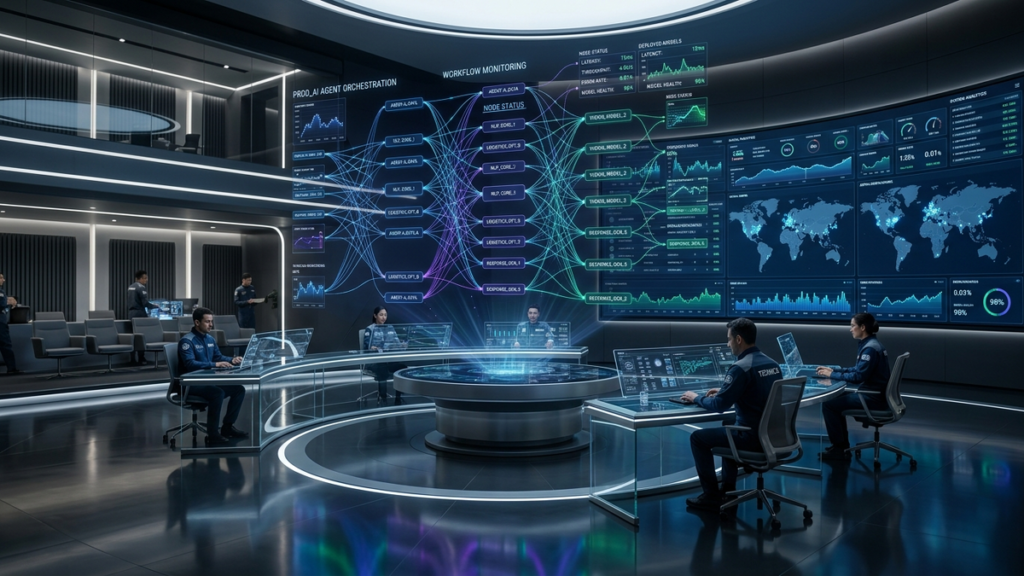
Autonomous artificial intelligence agents have evolved from experimental laboratory prototypes into fundamental pillars of modern enterprise software engineering. In 2026, building an AI agent is no longer simply about sending a single prompt to an LLM completion endpoint. Modern applications demand distributed multi-agent state machines, persistent memory stores, real-time contextual tool invocation, and deterministic error fallback systems.
At Ghayma LLC, our engineering teams architect intelligent systems that execute multi-step reasoning cycles across proprietary business datasets. In this comprehensive technical breakdown, we examine how to orchestrate production-grade AI agent pipelines combining LangChain, LlamaIndex, vector databases, and observability tooling.
1. The Shift from Simple RAG to Autonomous Agentic Frameworks
Traditional Retrieval-Augmented Generation (RAG) operates on a linear pipeline: a user submits a query, semantic similarity retrieves top-k chunk vectors, and an LLM synthesizes an answer. While effective for simple question-answering systems, linear RAG fails dramatically when faced with ambiguous tasks, complex business rules, and multi-step data transformations.
Why Agentic Workflows Outperform Traditional Linear Pipelines
Agentic workflows introduce dynamic feedback loops: Planning → Action Selection → Environment Observation → Reflection → Revision. Rather than guessing the final answer in one single execution, the agent verifies each sub-step against live tools and intermediate states.
Consider an enterprise logistics system where an agent must verify inventory across three warehouses, check active freight shipping rates, calculate localized VAT, and generate an approved purchase order. A linear prompt frequently hallucination rates, whereas an autonomous agent breaks the goal into sequential deterministic tools.
2. Orchestration Architecture: LangChain vs. LlamaIndex Synergy
Software developers frequently debate whether to choose LangChain or LlamaIndex. In enterprise software engineering, the best architectural pattern leverages both frameworks concurrently for their distinct core competencies:
- LlamaIndex as the Data Engine: Best suited for deep hierarchical document ingestion, complex vector indexing, graph RAG, and structured knowledge retrieval across heterogeneous databases.
- LangChain (LangGraph) as the Cognitive Orchestrator: Excels at cyclical state-machine management, conditional execution routing, agent coordination, and tool execution boundaries.
Architectural Blueprint
Below is a typical high-performance architecture utilized in Ghayma enterprise client deployments:
| Layer | Primary Technology | Core Responsibility |
|---|---|---|
| State Orchestration | LangGraph / Python 3.12 | State persistence, cyclic agent graphs, human-in-the-loop approvals |
| Data Ingestion & Indexing | LlamaIndex & Hybrid BM25 | Document parsing, chunk tokenization, multi-modal vector embedding |
| Vector Memory Store | Qdrant / Milvus Cluster | Sub-millisecond cosine similarity and payload metadata filtering |
| Inference Engine | vLLM / Enterprise API Endpoints | Quantized LLM execution with strict JSON schema constrained outputs |
| Observability & Tracing | OpenTelemetry & LangSmith | Token latency tracking, hallucination evaluation, tool execution telemetry |
3. Implementing Robust Memory Hierarchies
A primary failure mode of AI agents in production is context window overflow and short-term reasoning drift. To build agents that handle hour-long interactive sessions, engineers must implement a tiered memory hierarchy:
- Working Memory (In-Context Scratchpad): Ephemeral messages stored directly in the active LLM context window representing current turn reasoning steps.
- Episodic Memory (Session History): Redis-backed conversation cache with sliding window summarization to condense prior conversational turns without exceeding token budget.
- Semantic Memory (Long-Term Vector Store): Asynchronous vector embeddings representing permanent facts, user preferences, and business entity profiles persisted in Qdrant or Pinecone.
“In autonomous systems, memory is not just an archive; it is the cognitive filter through which current observations are evaluated and weighted.”
4. Tool Definition and Structured Schema Validation
An agent’s utility is directly proportional to the reliability of its external tool integrations. When agents generate arbitrary arguments, APIs inevitably fail. Modern production agents enforce strict Pydantic schemas using native function calling capabilities.
Every tool exposed to the agent must include exhaustive descriptions, typed parameters, validation bounds, and idempotent error handlers. If an external API returns a 503 service unavailable error, the agent should receive a formatted diagnostic message allowing it to choose an alternate strategy or retry gracefully rather than crashing the system session.
5. Guardrails, Cost Governance, and Production Telemetry
Deploying AI agents at scale introduces critical security and financial considerations:
- Prompt Injection & Jailbreak Mitigation: Implementing input sanitization layers like NeMo Guardrails to prevent adversarial inputs from manipulating the agent’s core instructions.
- Execution Loop Prevention: Enforcing strict max-iteration limits (e.g., maximum 8 tool steps per user objective) and cycle detection to prevent endless recursive loops that drain API balances.
- Token Cost Budgeting: Dynamically routing routine classifications to lightweight small language models (SLMs) like Llama 3 8B, reserving heavyweight reasoning models for complex planning synthesis.
Conclusion: The Future of Agentic Engineering
As intelligent agents become embedded across mobile applications, enterprise ERPs, and cloud microservices, mastering modular agent orchestration is the single most valuable skill in software engineering. By combining structured state graphs, robust memory tiers, and comprehensive observability, software teams can deliver autonomous AI systems that are reliable, performant, and truly production-ready.