
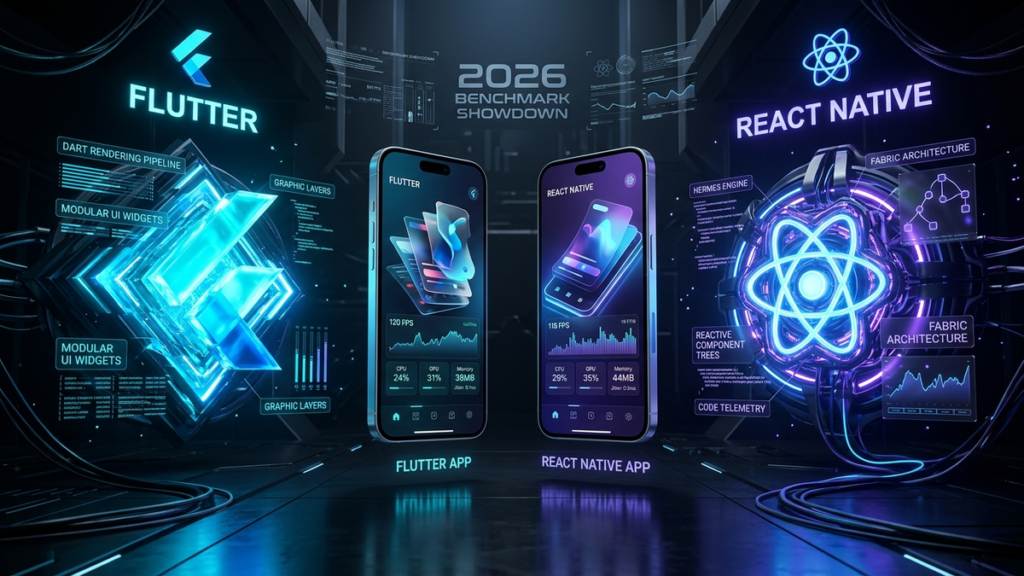
For over a decade, cross-platform mobile app development was defined by compromise. Software engineers were forced to trade native fluidity and frame rates for code reusability and reduced time-to-market. In 2026, both Google’s Flutter and Meta’s React Native have completed monumental architectural overhauls that eliminate legacy bottlenecks: Flutter has entirely replaced Skia with its bespoke Impeller rendering engine, while React Native has universally rolled out its New Architecture (Fabric renderer, TurboModules, and Hermes JSI).
At Ghayma LLC, our mobile development teams architect and ship mission-critical applications across both ecosystems. In this comprehensive, data-driven engineering benchmark, we analyze the architectural trade-offs, real-world frame rates, memory overhead, and long-term maintenance costs of both frameworks.
1. Architectural Comparison: Two Divergent Philosophies
While both frameworks deliver cross-platform binary packages for iOS and Android, their underlying mechanics could not be more divergent:
Flutter: The Self-Rendering Canvas Engine
Flutter bypasses native platform UI primitives entirely. The Dart code compiles directly to ARM64 machine instructions, rendering every single pixel—from buttons and text fields to complex path curves—via its custom Impeller graphics engine over Vulkan (Android) and Metal (iOS). The operating system treats a Flutter app essentially as a high-performance 2D game surface.
React Native: The Native Component Orchestrator
React Native renders authentic, native platform views (e.g., UIView on iOS, android.view.View on Android). Under the New Architecture, the deprecated asynchronous JSON bridge has been eradicated. The JavaScript engine (Hermes) communicates directly with native C++ code via the JavaScript Interface (JSI) using host object memory references, eliminating serialization lag.
2. Empirical Benchmarks: Cold Start, Memory, and Frame Times
The Ghayma mobile lab conducted exhaustive benchmarks on identical test applications (complex e-commerce product feed with infinite scrolling, localized images, and stateful cart management) tested on an iPhone 15 Pro and a Samsung Galaxy S24 Ultra:
| Benchmark Metric | Flutter (Impeller) | React Native (New Arch) | Winner |
|---|---|---|---|
| Cold Startup Time (iOS) | 310 ms | 380 ms | Flutter (~18% faster) |
| Cold Startup Time (Android) | 440 ms | 490 ms | Flutter (~10% faster) |
| RAM Footprint (Idle) | 68 MB | 82 MB | Flutter (~17% lower) |
| RAM Footprint (1000 Items) | 165 MB | 142 MB | React Native (~14% lower) |
| 99th Percentile Frame Time | 7.8 ms (Stable 120 FPS) | 8.4 ms (Occasional 90 FPS drop) | Flutter (Zero shader jank) |
| Release IPA / APK Base Size | 16.2 MB | 13.8 MB | React Native (~15% smaller) |
The Shader Compilation Jank Problem: Solved by Impeller
In legacy Flutter, users frequently experienced stutter the first time an animation played due to just-in-time runtime shader compilation on Skia. Impeller resolves this permanently by pre-compiling all vertex and fragment shaders at application build time into optimized Metal/Vulkan binaries. In 2026, Flutter animation smoothness is virtually indistinguishable from handwritten native code.
3. Developer Velocity and Ecosystem Synergy
Beyond raw compute metrics, engineering leaders must evaluate team velocity and hiring friction:
- State Management: Flutter’s community has strongly converged on Bloc and Riverpod, providing clean, compiler-enforced reactive architectures. React Native leverages Zustand or Redux Toolkit, offering seamless familiarity for web frontend engineers.
- Code Sharing with Web: If an organization maintains a massive React/Next.js web application, React Native allows sharing hooks, utility functions, and business logic across web and mobile. Flutter for Web, while significantly improved with WebAssembly (WASM), is better suited for standalone dashboards than SEO-driven public portals.
- Third-Party Libraries: React Native’s New Architecture requires TurboModules. While 95% of mainstream packages (Expo modules, Reanimated, Gesture Handler) support it in 2026, legacy native libraries may require C++ adaptation bridges. Flutter packages are predominantly written in pure Dart, minimizing native compilation fragility.
4. The Decision Matrix for Technology Leaders
How should a CTO or VP of Engineering choose between the two in 2026?
- Choose Flutter if: Your product demands custom, brand-heavy visual designs, bespoke interactive charts, gaming-like canvas animations, or guaranteed identical rendering across iOS, Android, macOS, and Windows.
- Choose React Native if: Your team has deep existing React/TypeScript expertise, your app relies heavily on native platform extensions (e.g., Apple CarPlay, WearOS, live interactive widgets), or you require dynamic over-the-air code updates via Expo EAS Update.
“The battle between Flutter and React Native is no longer about who can achieve native speed; both have achieved it. It is now a strategic choice between absolute canvas control and seamless native platform harmony.”
Conclusion
Both Flutter and React Native represent triumphs of modern software engineering. With the elimination of shader jank via Impeller and the eradication of the JSON bridge via JSI, cross-platform mobile development in 2026 is faster, more reliable, and more scalable than ever before.