
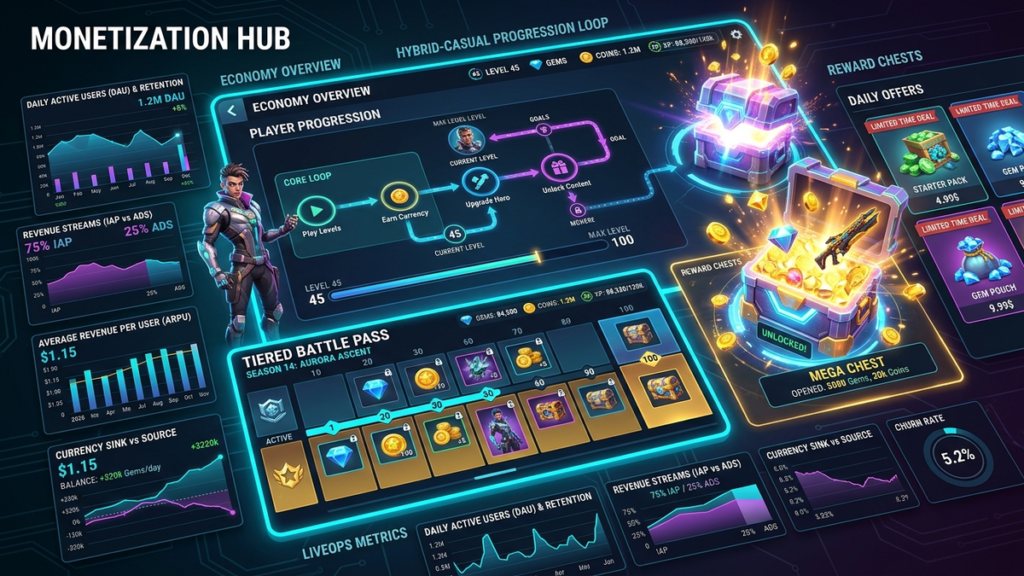
The mobile gaming industry has undergone a radical economic transformation over the past three years. The hyper-casual era—characterized by simple tap mechanics, relentless banner ad spam, and fleeting 3-day retention curves—has collapsed under rising user acquisition costs and stringent privacy frameworks (Apple’s App Tracking Transparency and Google’s Privacy Sandbox). In 2026, the dominant commercial model is Hybrid-Casual: marrying the instant accessibility of casual mechanics with deep meta-progression systems, rewarded video economy loops, and seasonal Battle Passes.
At Ghayma LLC, our game economy designers engineer balanced, ethical monetization models that optimize player Lifetime Value (LTV) while respecting user enjoyment and maintaining exceptional Day-30 retention. In this comprehensive industry guide, we explore the mathematics and mechanics of modern mobile game monetization.
1. The Fundamental Equation: LTV > CAC
Every commercial game studio lives or dies by a singular mathematical relationship: Customer Lifetime Value (LTV) must sustainably exceed Customer Acquisition Cost (CAC) across organic and paid marketing channels:
ROI = (LTV - CAC) / CACWhen user acquisition costs hover at $2.50 to $6.00 per install on modern ad networks, relying exclusively on forced interstitial ads generates only $0.40 in ad LTV, guaranteeing bankruptcy. The hybrid-casual model bridges this deficit by generating revenue across two synchronized streams:
- In-App Advertisements (IAA): Opt-in rewarded video ads that grant gameplay benefits, driving monetization across 95% of non-paying players.
- In-App Purchases (IAP): Microtransactions, cosmetic customizations, and seasonal Battle Passes purchased by the 3% to 5% high-engagement player cohort.
2. The Psychology of the Rewarded Video Loop
Intrusive, unskippable interstitial pop-ups drive players directly to the app store to leave 1-star reviews. In contrast, Rewarded Video Ads succeed because they transform advertising into a voluntary value exchange:
Designing High-Conversion Rewarded Placements:
- The End-of-Run Multiplier: “Watch a 30s video to 2x your collected gold coins from this dungeon raid.” (Over 65% opt-in rate).
- The Second-Chance Revive: “Revive your hero once per game session to finish the boss fight.”
- The Gacha Energy Refill: Offering stamina to continue playing immediately without waiting for a 20-minute timer.
By making ads entirely optional and highly rewarding, players perceive the advertisement as a core gameplay buff rather than an annoying interruption.
3. Battle Pass Architecture: The Retention Engine
The Battle Pass (or Season Pass) has universally replaced predatory randomized loot boxes as the gold standard of ethical, high-conversion microtransactions:
| Pass Tier | Cost | Player Psychology & Value Proposition |
|---|---|---|
| Free Track | $0.00 | Accessible to all players; establishes daily login habits and goal progression milestones |
| Premium Track | $4.99 – $9.99 | Unlocks exclusive cosmetic character skins, emotes, and accelerated progression items |
| VIP Booster Bundle | $14.99 – $19.99 | Instantly skips the first 20 tiers for time-constrained high-income players |
A properly structured Battle Pass achieves an astronomical Day-30 retention lift because it gives players a persistent daily narrative objective: “Play 3 matches to unlock Tier 18 today.”
4. Programmatic In-App Bidding Mediation
Gone are the days of manual “waterfalls” where developers manually ranked ad networks by estimated eCPM. Modern mobile monetization utilizes In-App Bidding (such as AppLovin MAX, Unity LevelPlay, or Google AdMob):
Every single time a player triggers a rewarded video placement, dozens of global advertising demand sources bid simultaneously in a real-time programmatic auction in milliseconds. The highest bidder wins the impression, maximizing studio revenue per thousand impressions (eCPM) without latency or manual maintenance.
“A game with brilliant art but broken economy design will perish in obscurity. A game with an ethical, addictive progression loop and balanced monetization builds an enduring multi-million-dollar franchise.”
Conclusion
Monetizing a mobile game in 2026 requires understanding the delicate equilibrium between game design, behavioral psychology, and programmatic ad technology. By shifting away from aggressive ad spam toward value-added rewarded video placements, transparent seasonal Battle Passes, and deep hybrid-casual meta-progression, game studios can build thriving, profitable businesses with devoted, happy player communities.